
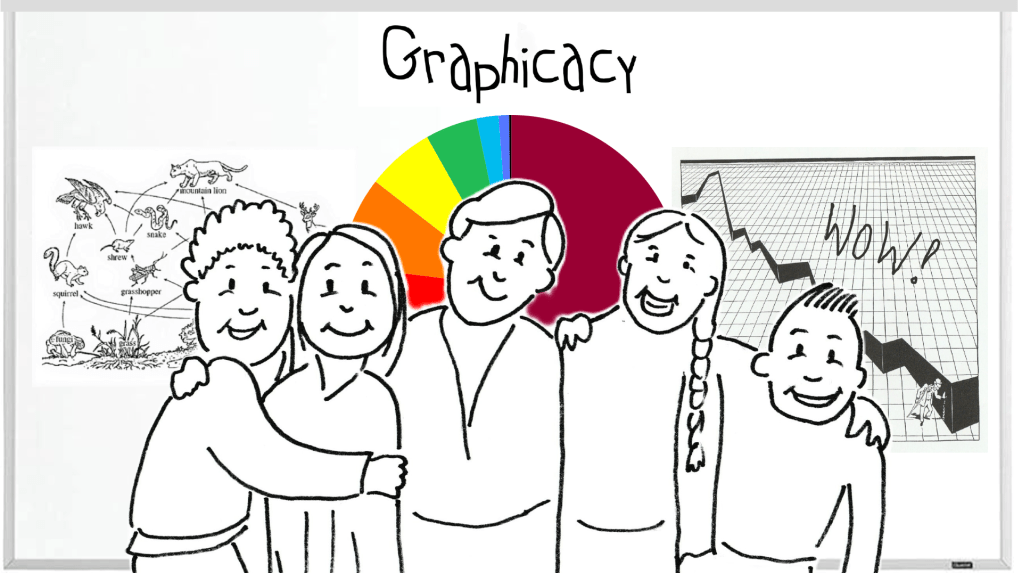
New World Definition of Graphicacy As Part of Language Arts
The Gist –
Graphicacy is the visual expression of facts, concepts, and emotions in diagrams, using both figurative images and written words, when neither words alone nor pictures alone would be adequate.
Comments –
Graphicacy is the knowledge, knowhow, and skills of creating graphics to convey emotions, factual information, and conceptualizations which cannot be readily communicated (if at all) with either just written-words or just pictures alone. This definition builds upon the 1965 coinage of British Physical Geographers W.G.V. Balchin and A.W. Coleman, which originally appeared in the UK Times Educational Supplement (OED & Graphicacy Wiki).
Graphicacy is a visual language-arts craft. It unites the written word and figurative images into expressive, informative, integrative constructions which get ideas across in memorable ways. In these graphic constructions the three expressive domains of the emotional (affect), the factual (information), and the conceptual (e.g., principles, relationships), are combined to various degrees, in various proportions, to create a single graphic depiction. Moreover, sequential graphics maybe used to tell a story, in a narrative where the details unfold in a series of visual panels. In this New World (largely American and Japanese), comics and graphic novels take us beyond the old world of maps, pie charts and wiring diagrams.
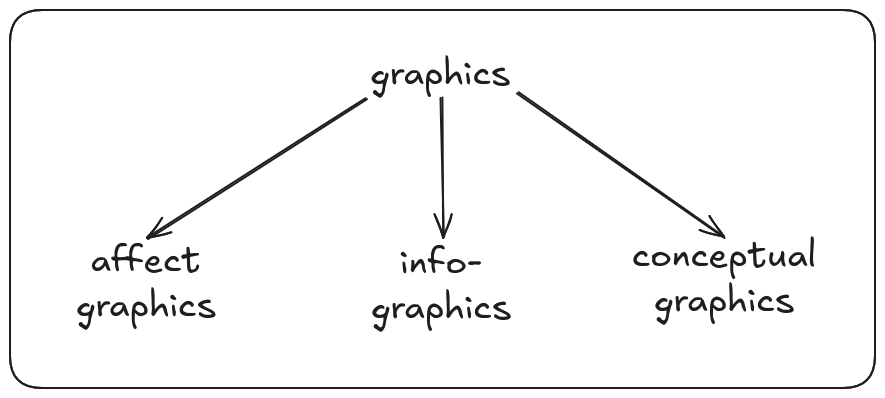
Three common types of graphics are recognized in Figure G. Examples of affect graphics are the photographs in the news of the bodies of dead Syrian children washed up on the shores of the Mediterranean. Info-graphics includes sports scoreboards, and networks showing the business connections of politicians. Examples of conceptual graphics are solar system diagrams and Figure G itself. These three categories or types of graphic intent are not necessarily mutually exclusive. A political cartoon, for example, may be informative, emotional, and conceptual, all at the same time.
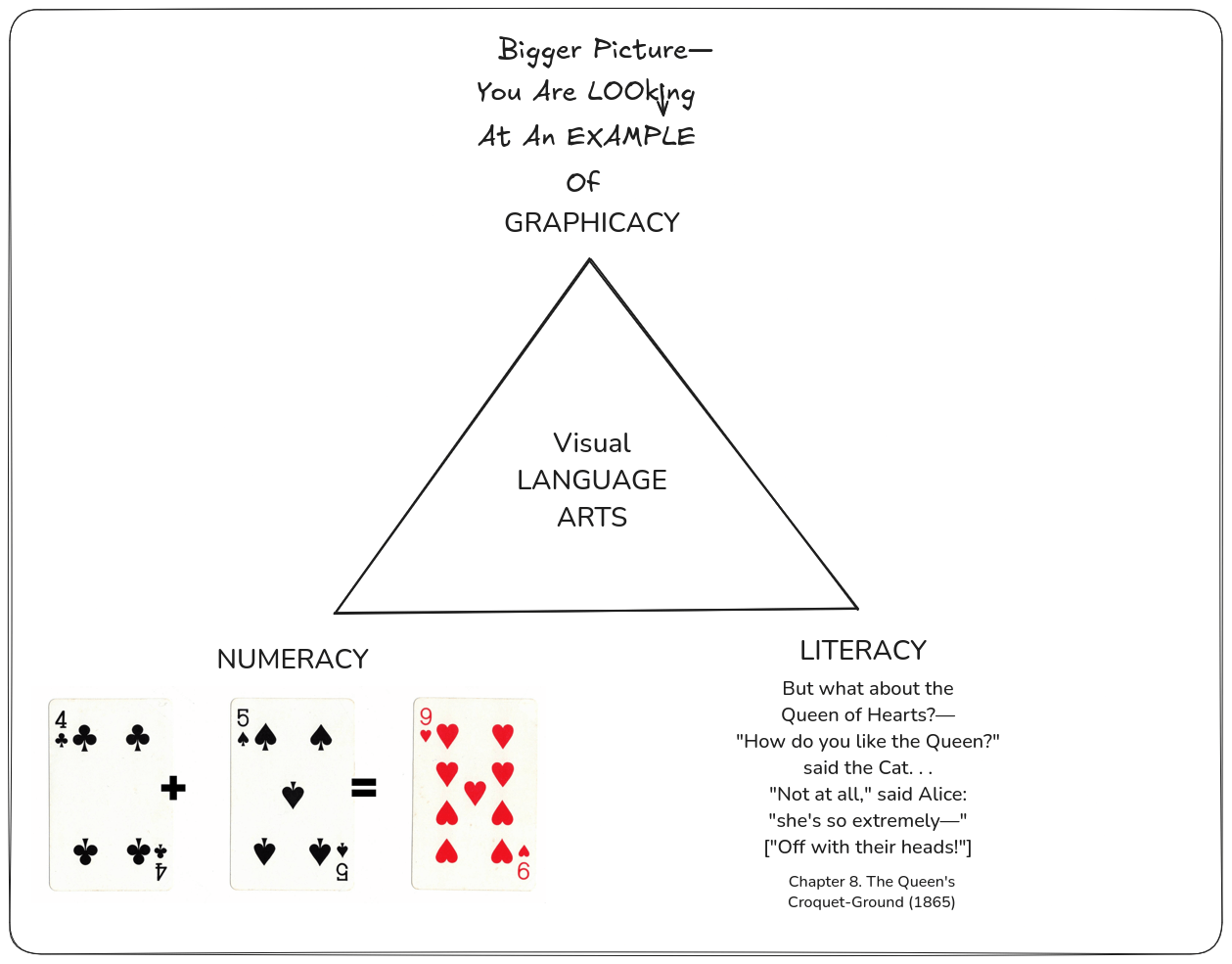
The Language Arts are four in number. Three of the four are dominantly visual: numeracy (the ‘maths’); literacy (reading-and-writing); and graphicacy. The fourth language art is articulacy, dominantly vocal, and traditionally taught as rhetoric and debate, although nowadays (when not remedial speech therapy) it is primarily taught as public-speaking. The three dominantly visual language arts are seen, and experienced, in the following graphic.
 Graphicacy